
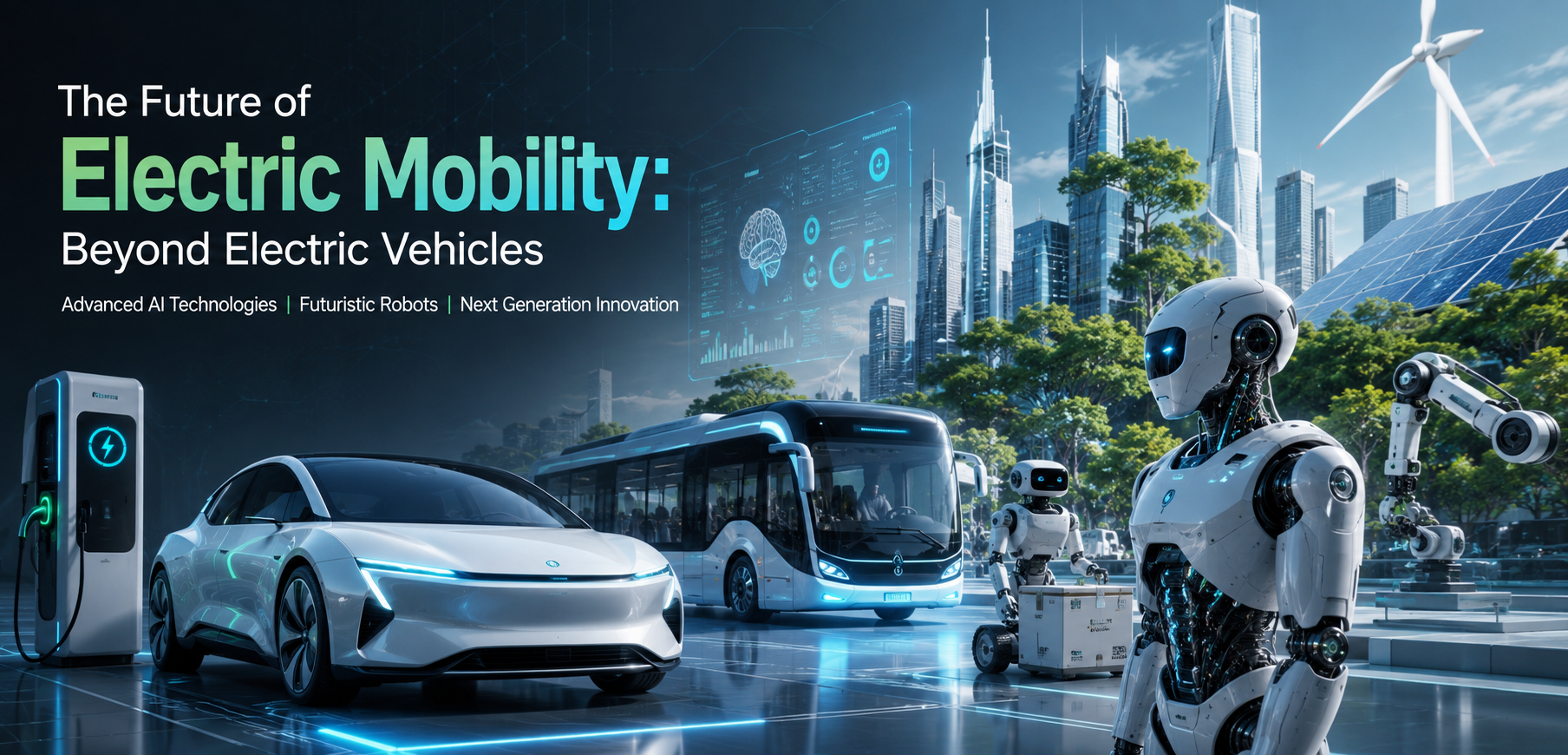
The Future of Electric Mobility - Beyond Electric Vehicles
The Future of Electric Mobility: Beyond Electric Vehicles | Electric vehicles were only the opening chapter. Explore the software, AI, batteries, and energy sys...
Written by Anvexa Team
Updated on September 17, 2026
The Future of Electric Mobility: Beyond Electric Vehicles | Electric vehicles were only the opening chapter. Explore the software, AI, batteries, and energy systems defining the next-generation EV era — and where Anvexa is crafting in. Target Keywords: future of electric mobility, EV technology, electric transportation, intelligent mobility, sustainable transportation, next-generation EV Suggested Category: Industry Insights Estimated Read Time: 8 min
The Future of Electric Mobility: Beyond Electric Vehicles
For decades, transportation has evolved through mechanical innovation—more powerful engines, improved fuel efficiency, enhanced safety, and better driving experiences. Today, however, the world is witnessing a transformation that extends far beyond replacing internal combustion engines with electric motors.
The future of electric mobility is not simply about producing electric vehicles (EVs). It is about creating an intelligent, connected, software-driven, and energy-integrated ecosystem where vehicles become smart computing platforms, batteries become distributed energy assets, charging infrastructure becomes part of national energy networks, and artificial intelligence continuously optimizes transportation.
This transformation represents one of the largest industrial shifts since the birth of the automobile.
At Anvexa, we believe electric mobility is only the beginning. The future belongs to integrated mobility ecosystems powered by intelligent energy, advanced software, and next-generation electrification technologies.
A Global Mobility Transformation, Not a Single-Product Shift
Electrification is no longer a passenger-car story. It's a systems story. Forklifts and reach trucks in warehouses, terminal tractors on ports, autonomous mobile robots on factory floors, golf carts, rickshaws, buses, and increasingly, boats — all are converging on the same underlying technology stack: lithium-based energy storage, intelligent power management, and connected controls.
This matters because sustainable transportation isn't a single market segment that a company can dominate by building one good product. It's a horizontal shift across every industry that moves people, goods, or materials. The organizations that will lead this decade aren't the ones with the best car — they're the ones with the deepest understanding of energy, mobility, and intelligence as a single, interconnected discipline.
Software-Defined Vehicles: The Platform Shift
For a century, a vehicle was defined by its mechanical engineering — the engine, the drivetrain, the chassis. That definition is inverting. Modern and next-generation EV platforms are increasingly defined by software: over-the-air updates that add capability after the sale, configurable performance profiles, and architectures where the vehicle keeps improving long after it leaves the factory. Software enables Over-the-air updates, Predictive maintenance, Feature upgrades, enhanced cybersecurity, Improved battery optimization, Personalized user experiences, and continuous performance enhancements
This is more than a feature list. It changes the business model of mobility itself — from a one-time hardware sale to an ongoing software and data relationship between manufacturer and customer. Any company serious about EV technology now has to think like a software company as much as a hardware one.
AI-Powered Transportation
Artificial intelligence is quietly becoming the operating layer of modern transportation — not just in headline-grabbing autonomous driving, but in the unglamorous work that determines whether a fleet is profitable. Predictive maintenance models that flag a failing cell before it fails. Route and energy optimization that squeezes more range out of the same battery. Fleet management systems that turn thousands of scattered data points into a single operational picture.
This is where intelligent mobility actually earns the name: not a marketing adjective, but a measurable reduction in downtime, cost, and risk.
Battery Innovation: The Real Engine of Progress
Ask most people what's driving the future of electric mobility and they'll say "better batteries." They're only half right. Cell chemistry matters, but the more consequential innovation is happening around the cell — in the Battery Management System (BMS) that decides how it's charged, protected, and preserved over its lifetime.
A truly intelligent battery does three things a basic one can't: it manages thermal behavior in real time to protect performance and safety, it adapts charging and discharge patterns to extend usable life, and it reports its own health continuously instead of failing silently. As industries push batteries into harsher, higher-utilization environments — port equipment, 24/7 logistics fleets, marine applications — this layer of intelligence is becoming the real differentiator, not the chemistry alone. The battery is no longer just a vehicle component—it is the foundation of modern electric mobility.
The next decade will be defined by innovations that improve:
- Energy density
- Charging speed
- Safety
- Thermal management
- Lifecycle performance
- Sustainability
- Cost efficiency
- Intelligent battery analytics
Advanced Battery Management Systems (BMS) are becoming equally important.
Modern BMS platforms monitor thousands of parameters in real time, enabling:
- Longer battery life
- Improved safety
- Faster charging
- Enhanced reliability
- Better energy utilization
- Predictive health monitoring
Battery intelligence will increasingly become a major competitive differentiator across the mobility industry.
The Charging Ecosystem Is Catching Up
Vehicles have moved faster than the infrastructure meant to support them, and closing that gap is one of the defining engineering challenges of this decade. Fast-charging standards are converging, charging networks are densifying, and vehicle-to-grid (V2G) concepts — where parked batteries feed power back into the grid during peak demand — are moving from research papers toward real deployments.
The same gap exists, less visibly, in industrial settings. A warehouse running electric forklifts across multiple shifts has charging infrastructure demands every bit as complex as a public highway corridor — just with less attention paid to them. Solving for electric transportation at scale means solving charging for the depot and the factory floor, not just the driveway.
Smart Energy Integration
Mobility and stationary energy storage are converging. The battery chemistry and management intelligence inside an electric vehicle or forklift is fundamentally the same technology inside a solar energy storage system or a UPS backup unit. Forward-looking companies are starting to treat mobility and energy storage as one integrated portfolio rather than two separate businesses — pairing solar generation with storage, and storage with fleets, to build resilient, self-sufficient industrial energy systems.
This integration is where sustainable transportation and sustainable operations start to reinforce each other, rather than compete for capital.
Connected Vehicles and the Data Layer
A vehicle or industrial machine that can't report its own status is, in 2026, already behind. Real-time telematics, remote diagnostics, and predictive health monitoring have shifted from premium features to baseline expectations — particularly for corporate fleet operators who measure success in uptime and total cost of ownership, not just purchase price. The vehicle is no longer just a machine that moves; it's a continuous stream of operational data that, used well, prevents failures before they happen.
Autonomous Mobility Is Already Here — Just Not Where Everyone's Looking
Public conversation about autonomy tends to fixate on self-driving cars. But autonomous mobility is already operating at scale — inside warehouses and distribution centers, in the form of Autonomous Mobile Robots (AMRs) and Autonomous Guided Vehicles (AGVs) navigating factory floors and fulfillment centers every day. These systems demand a different class of power source: compact, precisely monitored, communicating in real time with the vehicle's control systems over protocols like CAN.
Industrial autonomy is, in effect, the proving ground for the intelligent power systems that broader autonomous mobility will eventually require on public roads.
How Anvexa creates the Ecosystem
Every trend above — software-defined platforms, AI-driven optimization, intelligent batteries, charging infrastructure, smart energy integration, connected data, and autonomous systems — points to the same conclusion: the future of mobility won't be won by improving one component in isolation. It will be won by whoever understands the full system.
That conviction is the reason Anvexa exists. What began in 2023 as an internal initiative, North Star X, to build a genuinely energy-efficient system became Anvexa Technologies in 2024 — built on the premise that energy, mobility, and intelligence needed to be engineered together, not bolted on after the fact.
That's why Anvexa's battery technology spans material handling equipment, energy storage systems, and electric vehicles rather than a single category — because in practice, a forklift battery, a solar storage system, and an EV pack are converging technologies, not separate markets. Every product line carries the same core intelligence: advanced BMS architecture, smart thermal management, and real-time telematics with predictive health monitoring — the practical, deployed version of the "AI-powered, connected" future the industry is still describing in the future tense.
What This Means, Depending on Where You Sit
For investors, this is a market defined by convergence, not a single hyped category — and companies built around the full energy-mobility-intelligence stack, rather than one product, are positioned to capture value across multiple electrifying industries at once.
For industry professionals and corporate customers, the practical question isn't whether to electrify — it's which partner brings the BMS intelligence, telematics, and support to keep fleets running at the uptime and total cost of ownership your operations demand.
For media, the more interesting story is no longer "another EV company" — it's how energy, software, and intelligence are being rebuilt from the ground up across industries far beyond the passenger car.
For future team members, this is a company still writing its founding chapter — an opportunity to help define, from first principles, what an intelligent energy ecosystem looks like.
The Road Ahead
Electric vehicles proved that electrification works. What comes next — software-defined platforms, AI-powered optimization, intelligent batteries, integrated energy systems, and autonomous machines — will prove how far it can go. The companies that treat these as one connected discipline, rather than separate trends, will define the next decade of next-generation EV and industrial mobility technology.
Anvexa is building for that future — not by waiting for it, but by engineering it.